Webinar
Salesforce CPQ to Revenue Cloud Migration
Learn the differences between Salesforce CPQ and Revenue Cloud, plus migration best practices and insights from Max Rudman to optimize your strategy.
In this video
Key differences between CPQ and the New Revenue Cloud Migration Framework and Process
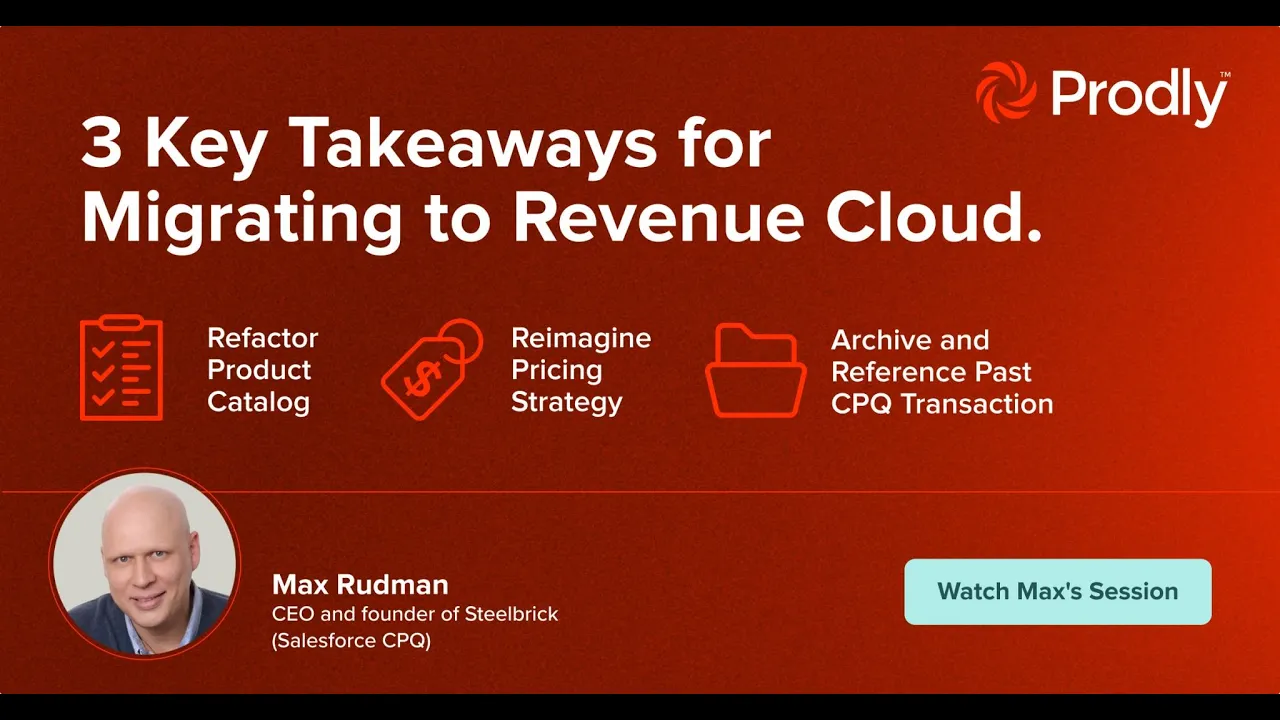
Max Rudman, CEO of Prodly and former founder of Steelbrick (the original Salesforce CPQ), presents a comprehensive guide on migrating from Salesforce CPQ to Revenue Cloud.
Revenue Cloud is a newer Salesforce product built natively on the Salesforce platform with standard objects, offering improved performance, reliability, and an API-first design, unlike the managed package CPQ. It supports a more complex, enterprise-level data model and is designed for omni-channel sales, unlike CPQ which was built mainly for direct sales.
Successful migration requires a combination of Prodly's data migration platform and advisory services for redesigning product catalogs and pricing to leverage Revenue Cloud's capabilities. The migration framework categorizes tasks into automated, assisted, and manual migrations, with examples such as product bundles migrating automatically, configuration/product rules requiring assistance, and price rules needing manual redesign.
6 Key Steps to Help You Along Your Migration Journey:
Analysis of CPQ data
Product catalog migration
Pricing migration
Transactions migration
Install base migration
Quality assurance
The analysis tool flags problematic configurations like orphan options or unsupported features. Product catalog migration covers features, options, bundles, attributes, and rules, with some requiring manual intervention due to differences in Revenue Cloud. Pricing migration can automate basic discount schedules but advanced discount schedules and price rules need manual handling or redesign. Transactions migration focuses on current quotes and orders, as migrating historical transactions is impractical due to differing pricing engines. Install base migration consolidates CPQ subscriptions and assets into Revenue Cloud's managed assets, which track state changes more effectively.
Key takeaways emphasize refactoring product catalogs, reimagining pricing architecture, and not attempting to migrate past transactions but archiving them instead. Max invites questions and offers Prodly's expertise for migration and Salesforce DevOps support.
Transcript

© 2026 Prodly. All rights reserved.